Content#
|
Adjacency matrix of the graph. |
|
Yields all shortest paths from source to target. |
|
Returns the assortativity of the graph. |
|
Returns the average shortest path length between sources and targets. |
|
Bayesian Blocks Implementation |
|
Returns the normalized betweenness centrality of the nodes and edges. |
|
Betweenness distribution of a graph. |
|
Binning function providing automatic binning using Bayesian blocks in addition to standard linear and logarithmic uniform bins. |
|
Returns the closeness centrality of some nodes. |
|
Returns the connected component to which each node belongs. |
|
Degree distribution of a graph. |
|
Returns the diameter of the graph. |
|
Return the B2 coefficient for the neurons. |
|
Return the average firing rate for the neurons. |
|
Return a 2D sparse matrix, where: |
|
Returns the global clustering coefficient. |
Returns the undirected global clustering coefficient. |
|
|
Compute the local closure for each node, as defined in [Yin2019] as the fraction of 2-walks that are closed. |
|
Local (weighted directed) clustering coefficient of the nodes, ignoring self-loops. |
Returns the undirected local clustering coefficient of some nodes. |
|
|
Return node attributes for a set of nodes. |
|
Returns the number of inhibitory connections. |
Calculate the edge reciprocity of the graph. |
|
|
Returns the length of the shortest paths between sources`and `targets. |
|
Returns a shortest path between source`and `target. |
|
Returns the small-world propensity of the graph as first defined in [Muldoon2016]. |
|
Spectral radius of the graph, defined as the eigenvalue of greatest module. |
|
Returns the subgraph centrality for each node in the graph. |
|
Computes the total firing rate of the network from the spike times. |
|
Same as |
|
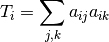
Returns the number or the strength (also called intensity) of triangles for each node. |
|
Returns the number or the strength (also called intensity) of triplets for each node. |
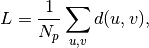
 is the number of paths between sources and targets,
and
is the number of paths between sources and targets,
and  is the shortest path distance from u to v.
 , with
  the number of nodes in the graph.
 from u to the N - 1 other nodes in the graph (if mode is “out”,
reciprocally
from u to the N - 1 other nodes in the graph (if mode is “out”,
reciprocally  , the distance to u from another node v,
if mode is “in”):
, the distance to u from another node v,
if mode is “in”):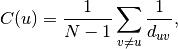
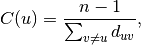
 ),
while the distance itself is taken as zero for unconnected nodes in the
first equation.
),
while the distance itself is taken as zero for unconnected nodes in the
first equation. , the normal (or Zhang-like) definition is given
by:
, the normal (or Zhang-like) definition is given
by:
![H_i = \frac{\sum_{j\neq k} \sqrt[3]{w_{ij} w_{jk} w_{ki}}^2}
{\sum_{j\neq k\neq i} \sqrt{w_{ij}w_{jk}}}
= \frac{\left( W^{\left[ \frac{2}{3} \right]} \right)_{ii}^3}
{\sum_{j \neq i} \left( W^{\left[ \frac{1}{2} \right]}
\right)^2_{ij}}](../_images/math/ce61fb6a10ab28c4c4643817103d858aab66aff5.png)
![W^{[\alpha]} = \{ w^\alpha_{ij} \}](../_images/math/c68763824a8a0af3bf2b09d0533649353af80ae0.png) .
. connected to nodes
  and
and  :
:![C_i = \frac{\sum_{jk} \sqrt[3]{w_{ij} w_{ik} w_{jk}}}
{\sum_{j\neq k} \sqrt{w_{ij} w_{ik}}}
= \frac{\left(W^{\left[\frac{2}{3}\right]}\right)^3_{ii}}
{\left(s^{\left[\frac{1}{2}\right]}_i\right)^2 - s_i}](../_images/math/65dc4269d66313fff39c57a052e948d6fd179462.png)
 the normalized
weight matrix,
the normalized
weight matrix,  the normalized strength of node
 ![s^{[\frac{1}{2}]}_i = \sum_k \sqrt{w_{ik}}](../_images/math/b4993ffea0f6fc05f852fc3467f69c928253bb62.png) the strength associated
to the matrix
the strength associated
to the matrix ![W^{[\frac{1}{2}]} = \{\sqrt{w_{ij}}\}](../_images/math/81c8789346aca300ceb0c36499475cd6a2ea808d.png) .
.![C_i = \frac{\frac{1}{2}\left(W^{\left[\frac{2}{3}\right]}
+ W^{\left[\frac{2}{3}\right],T}\right)^3_{ii}}
{\left(s^{\left[\frac{1}{2}\right]}_i\right)^2
- 2s^{\leftrightarrow}_i - s_i}](../_images/math/22f259314b7c99d27f74cc02af706530290ac076.png)
 the
reciprocal strength (associated to reciprocal connections).
the
reciprocal strength (associated to reciprocal connections).![\phi = 1 - \sqrt{\frac{\Pi_{[0, 1]}(\Delta_C^2) + \Pi_{[0, 1]}(\Delta_L^2)}{2}}](../_images/math/299cb35b8df9a39286a3209511c717fbf1dfeef4.png)
 the clustering deviation, i.e. the relative global or
average clustering of g compared to two reference graphs
the clustering deviation, i.e. the relative global or
average clustering of g compared to two reference graphs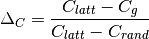
 the deviation of the average path length or diameter,
i.e. the relative average path length of g compared to that of the
reference graphs
the deviation of the average path length or diameter,
i.e. the relative average path length of g compared to that of the
reference graphs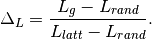

 is the (potentially weighted and normalized) adjacency
matrix.
is the (potentially weighted and normalized) adjacency
matrix.