Content#
Generation functions#
|
Generate a graph where all nodes are connected. |
|
Generate a circular graph. |
|
Create a graph using a 2D distance rule to create the connection between neurons. |
|
Generate a random graph as defined by Erdos and Renyi but with a reciprocity that can be chosen. |
|
Generate a random graph with constant in- or out-degree. |
|
Generate a random graph from a given list of degrees. |
|
Generate a random graph with constant in- or out-degree. |
|
Generate a (potentially small-world) graph using the Newman-Watts algorithm. |
|
Generate a Price graph model (Barabasi-Albert if undirected). |
|
Generate a free-scale graph of given reciprocity and otherwise devoid of correlations. |
|
Generate a sparse random graph with given average clustering coefficient and degree. |
|
Generate a (potentially small-world) graph using the Watts-Strogatz algorithm. |
Connectors#
|
Function to connect nodes with a given graph model. |
|
Function to connect groups with a given graph model. |
|
Function to connect excitatory and inhibitory population with a given graph model. |
Rewiring functions#
|
Generate a new rewired graph from g. |
|
Build a (generally irregular) lattice by rewiring the edges of a graph. |
 , whereas for the
exponential distance-rule,
, whereas for the
exponential distance-rule,  .
. ).
). ), ‘mm’, ‘cm’,
‘dm’, ‘m’.
), ‘mm’, ‘cm’,
‘dm’, ‘m’. . It is also the
probability for each possible edge in the graph to exist.
. It is also the
probability for each possible edge in the graph to exist.
 the number of nodes in the graph.
 previous nodes, chosen with probability:
 is the (in-)degree of the vertex.
 for directed graphs and
 for undirected graphs.
 is non-zero, each targeted node reciprocates
the connection with probability
is non-zero, each targeted node reciprocates
the connection with probability  .
. , and reciprocity is zero, the tail of resulting
in-degree distribution of the directed case is given by
, and reciprocity is zero, the tail of resulting
in-degree distribution of the directed case is given by

 , the in-degree distribution is not
scale-free.
, the in-degree distribution is not
scale-free. , such that

 , such that

 .
Parameter nodes is required unless from_graph or population is
provided.
.
Parameter nodes is required unless from_graph or population is
provided. overlapping groups of size
 and, each time two nodes belong to a common group, they are
connected with a probability
and, each time two nodes belong to a common group, they are
connected with a probability  .
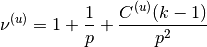
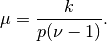
. , and the average clustering as:
![C^{(u)} = \frac{p \left[ p(\nu - 1) - 1 \right]}{k - 1}](../_images/math/59f0514d7ebdd2bb7d134d0ffa467180050bc051.png)
![C^{(d)} = \frac{p\mu \left[ p(2\nu - 3) - 1 \right]}{2k - 1 - p}](../_images/math/20c53f3e7d31ca06ea2ed144caeb22632cc7b335.png)